

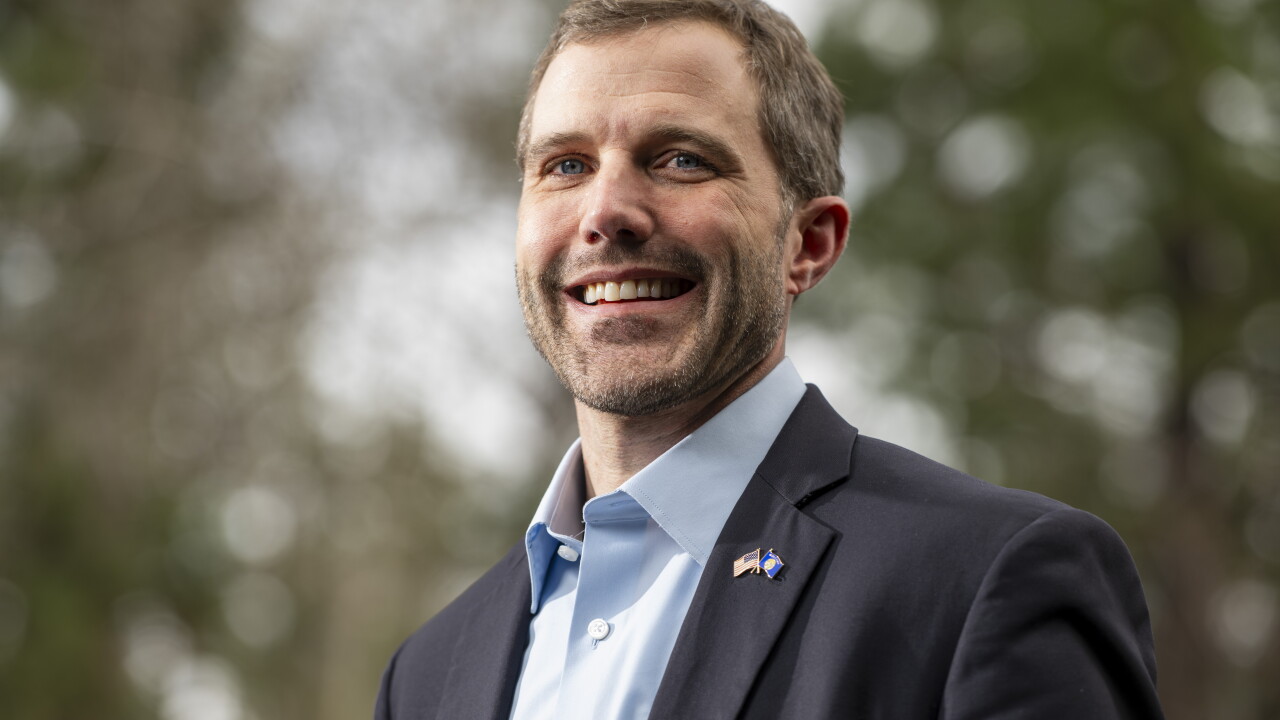


MISSOULA — Montana voters have never elected a candidate to Congress without a political party label. However, former University of Montana President Seth Bodnar hopes this is the year that streak ends. MTN's Mark Martin sat down with Bodnar, the independent candidate in the race for U.S. Senate.
Watch the full story here:
Bodnar says he is guided by a lifelong commitment to duty, honor, and country. He served a decade on active duty, a time that would take him around the world as a Green Beret. He transitioned into a business career with GE, and then almost nine years ago, moved to Montana and became the president of the state's flagship university.
"Far and away, the most important thing, though, about me is I'm a dad. I'm a dad raising three kids here, and they are the reason that my wife and I decided to jump into this race," the 47-year-old told MTN.
Bodnar is in a four-way race for U.S. Senate, running against Republican Kurt Alme, Democrat Alani Bankhead, and Libertarian Kyle Austin.
"A big thing that your opponents are saying is that you're a phony independent and that you're a liberal in disguise. What are your thoughts to that?" MTN asked.
"I'm an Independent, and I swore an oath when I joined the military at the age of 18-- I swore an oath to the Constitution, not to a political party," Bodnar responded.
His campaign is staffed by members of former U.S. Senator Jon Tester's political operation. The Democrat has endorsed Bodnar, and Tester reportedly described the Democratic label as being "poison" to his 2024 reelection campaign. Bodnar has a different take.
"When I talked to John Tester about running for the United States Senate, he said first and foremost, 'You have the best job in Montana; don't leave that job.' And second, he said, 'If you're going to run, you should run as a Democrat.' And I said, 'You know what, Senator, I appreciate that; I respect that, but I see a political system that's failing us,'" Bodnar explained.
Still, Bodnar's campaign accuses his opponent on the left, Bankhead, of being comfortable with "far-right views" when it comes to abortion and says she attended a "pro-MAGA megachurch" in Virginia.
"This doesn't add up, and we're tired of politicians who say one thing, but believe another and act in another way, so we're going to draw that contrast," he shared.
"Would you say, is she more on the left than you? Is that a fair assessment?" MTN asked.
"I think that's for folks to assess. I'm not sure; I'm not sure. What I do know is that this campaign-- we're building a broad coalition," he answered.
Ten Questions:
MARK MARTIN: “These are the basic questions that we're asking all the candidates and putting on our website. The first one is, should the federal government be putting more restrictions on data centers? Should local communities have an absolute right to say no to construction in their area?”
SETH BODNAR: “Absolutely. We need strict guidelines. We need guardrails in place immediately to make sure that no big tech company can come in here and put a data center into a Montana community without the community's involvement. We need to make sure that we don't have our water threatened. We don't have our power rates jacked up by big tech companies. And I'm the only candidate who's laid out a broader plan not just for AI, excuse me, not just for data centers, you know to pretend to prevent big tech from exploiting Montana communities with data centers. But we also have to protect our kids from these AI models and chatbots. We have to protect our workers from being displaced by AI and big tech companies walking away with all the profits. We have to protect our rural infrastructure, our power grids, our water systems from the risk of cyber attack due to the broader use of AI, and frankly we need to protect humanity. We need strict guardrails in place immediately to make sure that Montanans aren't taken advantage of.”
MARK MARTIN: “Next question, sir, is, are there actions Congress could be taking to help improve the supply of accessible affordable housing in Montana?”
SETH BODNAR: “Oh, absolutely. Expanding the supply is an urgent crisis. Everywhere I go, young families can't afford to buy a home in the very community in which they were raised. Teachers who can't afford to live in the communities that they're serving. People on Social Security. Rents continuing to increase and they're being pressured out of their homes. I hear this in every part of the state. So, our housing situation is a crisis and federal government needs to do a few things. First and foremost, incentivize more building; you know the zoning and code reform to unlock more supply. Second, we need smart, targeted investment in infrastructure to give that last mile of water, sewage, roads to unlock developments. We need smart financing supporting USDA 502 loans and efforts like that to get people into housing and then, importantly, we need to stop the wars. Stop the war in Iran that's driving up costs of diesel and fertilizer, but so many other things, and then stop these senseless trade wars. This is a time when we urgently need to bring prices down, and engaging in senseless trade wars with our neighbor in the north, Canada, is driving up prices for everything and that's making the housing situation worse.”
MARK MARTIN: “Okay, and then, are you supportive of the more aggressive federal immigration enforcement that we've seen under the Trump administration?”
SETH BODNAR: “Here's what I believe about immigration, and I think most Montanans and most Americans are here. Number one, we need to have strong borders, and we need to enforce our immigration policies. Number two, we can, and we must, do that without allowing an unaccountable, untrained, masked force to run through our cities, trampling on the individual liberties of American citizens and ignoring due process rights. And number three, we need comprehensive immigration reform for people to be here legally and do it more simply. And I talk to farmers that are deeply concerned about the H2A visa challenges. We need labor. We need a workforce. The problem with immigration is it's an issue of political will. We know what we need to do in terms of comprehensive immigration reform, but right now we have politicians in D.C. who would rather use this as an issue to fight over rather than an issue that it's their responsibility to solve. I'll change that.”
MARK MARTIN: “Okay. And the next one is, do you think, you kind of already touched on this, so if you don't want to elaborate anymore, it's okay. Do you think the Trump administration's tariff policy has been successful? Should anything be done to help Montana businesses who say they've been harmed?”
SETH BODNAR: “Tariffs should be used as tools, strategic tools to open markets for our farmers, for ranchers, to protect key industry. Right now, we see tariffs being used like toys. Senseless, non-strategic tariffs, engaging in a trade war with Canada, our neighbor to the north, our most important trading partner here in Montana, but across the country and an important ally. At the same time, you see us putting restrictions in place with Canada that are costing farmers in terms of potash, in terms of replacement parts, costing small businesses, everybody, all the trade that goes back and forth with Canada. When you put this trade war in place, you're driving up costs for everybody. To see that trade policy at the same time, when we're allowing 660 million pounds of foreign beef to be dumped in our market at 25% below cost, hurting ranchers across this state, it's nonsensical. We need smart, common-sense trade policy that supports our farmers and ranchers, allows them to compete and win, that supports our small businesses, that lowers prices, that protects national security. Right now, our trade policy's a mess.”
MARK MARTIN: “Okay. Then the next one, do you want to make any changes to the tax policy that Congress passed in the big, beautiful bill last year?”
SETH BODNAR: “We need a tax code that's fair, where everybody pays their share. I'm not for punishing people who've done well. If you've done great and you have two houses and a boat, good for you, this is America. But we shouldn't punish work so heavily. Our tax code: if you make $75,000 a year, you're paying payroll taxes, you're submitting a W-2, your tax return's pretty simple. If you're pulling in multi-millions or billions of dollars a year, you have a very complex tax code. You're spending tens or hundreds of thousands of dollars on an accountant to find every loophole that you can. So, you have a scenario in which sometimes you have people at the extreme upper end of the income scale paying a lower rate than somebody at the bottom. That's not fair. We need a tax code that is fair.”
MARK MARTIN: “Okay. And the next one, do you want to see further changes to eligibility requirements for benefits like Medicaid and SNAP?”
SETH BODNAR: “You know, unfortunately, what we've seen right now with this so-called big, beautiful bill last year is you saw eligibility verification requirements change, you know, creating effectively a paperwork trap for people to prove their eligibility for Medicaid. Those changes are likely to cause about 30,000 Montanans, according to the Montana Hospital Association, to lose access to their Medicaid coverage. That is going to have catastrophic effects, particularly in rural Montana. Our rural hospitals, so we have about 50 of them in Montana, they're already in financial challenge. About two-thirds of them have considered cutting certain types of services; about a third are on the brink of financial collapse. And these changes to Medicaid, kicking 30,000 Montanans off of those benefits, those are going to have a very, very negative impact, particularly on our rural hospitals. And when you lose a rural hospital in a community, you don't just lose access to vital medical care; you lose a key job driver, you lose a hub of a community. This is something we need to reverse.”
MARK MARTIN: “Okay, next one. Social Security is projected to be unable to pay full benefits by 2032. How should Congress respond to that?”
SETH BODNAR: “This is vitally important, and Montanans need to know that the U.S. Senator who they send to Washington, D.C. this November will have a key seat at the table in deciding how we deal with this issue in 2032, because it's estimated, and Montanans need to know this, that benefits will see a 22% reduction in 2032 if nothing is done. Now, the fix is relatively simple. We have a cap on income that's taxable for Social Security purposes. That cap's about $184,000. That means so if you make $100,000 a year, 100% of your income is taxable for Social Security purposes. If you make $2 million a year, less than 10% of your income is taxable for Social Security purposes. That's not fair. We can raise the cap, eliminate that cap, and that gets us most of the way there to fixing the Social Security challenge and keeping that system solvent. Montanans paid into that system; they deserve to receive their benefits.”
MARK MARTIN: “Okay, next question, Seth. What role, if any, should the federal government play in regulating abortion?”
SETH BODNAR: “I am a strong supporter of a woman's reproductive freedom. A woman's decisions about her health and her body should be between that woman, her doctor, her family, and if she so chooses, her faith.”
MARK MARTIN: “Okay, next one. Do you support the Trump administration's decision to repeal the nationwide Roadless Rule? Do you want to see changes in how the federal government manages federal lands?”
SETH BODNAR: “We need to, first and foremost, protect our public lands. Our public lands are our common ground, where everybody, regardless of how much money they make, can hunt, fish, recreate. They're vitally important to the Montana way of life. We look at things like the Roadless Rule. No, we should not repeal the Roadless Rule. We already have about 30,000 miles of road on Forest Service land in Montana. The federal government can't maintain to begin with. Those roadless areas are very important habitat and migration corridors for wildlife across this state. Vitally important. There's no reason to repeal the Roadless Rule. And at the same time, we need to make sure that we're funding our Forest Service, our BLM, national park service. You have a situation right now where Yellowstone National Park, which is a crown jewel, of this country, Yellowstone and Glacier, vitally important for this country. Vitally important for our economy, over, you know, estimated about 10 million plus visitors every year to the parks. We see right now, though, park fees being siphoned away. Yellowstone National Park, I saw, recently had trouble paying for toilet paper. We need to support our national parks. It's vitally important for this country, and it's crucial for the economic health of Montana. I will support, protect our public lands, support our national parks, our BLM lands, make sure that the incredible natural treasures of the Treasure State are protected for generations to come.”
MARK MARTIN: “And then the final general question that we're asking all the candidates, how do you think... you kind of touched on this already... How do you think the U.S. should be approaching the ongoing conflict in Iran, the Middle East?”
SETH BODNAR: “So, I was a U.S. Army Green Beret. I know very clearly and tangibly the threat of Iran. That regime has been responsible for the death of friends of mine. At the same time, I take very seriously the decision of the Commander-in-Chief to send America's sons and daughters into harm's way. And I take very seriously the constitutional obligations of a United States Senator. My opponent, Kurt Alme, when he talks about the Iran war, says that we need to support the President. No, that's a fundamental misunderstanding of the job of a U.S. Senator. Your job is not to just blindly support the President of either party. Your job is to do the constitutional duty articulated in Article I of the United States Constitution. It is Congress's job to declare war. And that's important because that is supposed to be an important check of balance on the Commander-in-Chief. The Commander-in-Chief should have to articulate before he or she sends America's sons and daughters to shed blood on foreign soil. Congress is supposed to force the Commander-in-Chief to articulate why this is an imminent threat. What is the plan? What is the exit strategy? Congress has failed in its duty due to blind partisan loyalty. And that's the reason we have a war in Iran with no clear strategy, a war that we are currently losing, a war with no off-ramp where we're losing every single day. You know, more Americans to injury. We've lost many Americans. We've lost their lives. And we see back here, Montana is paying $6.30 for a gallon of diesel, fertilizer prices through the roof, everything costing more because Congress has failed to do its job.”
