


LAUREL — For the first time, residents in Laurel are hearing from the state of Montana about the forensic mental health facility planned for a 114-acre lot just outside of Laurel city limits. It's been months of pushback from residents and county commissioners, who say both state and local officials have not been transparent about the process of bringing the facility to town.
Watch full video below:
On Monday, the Montana Department of Health and Human Services presented an update in Helena to legislators, highlighting what it describes as myths surrounding the 32-bed forensic mental health facility. Community members and local officials argued with those findings, so MTN News took a deeper dive to determine what's myth, and what's fact.
One myth from the state: Patients will be discharged from the facility into the community and strain local resources. This was shot down by DPHHS Director Charlie Brereton.
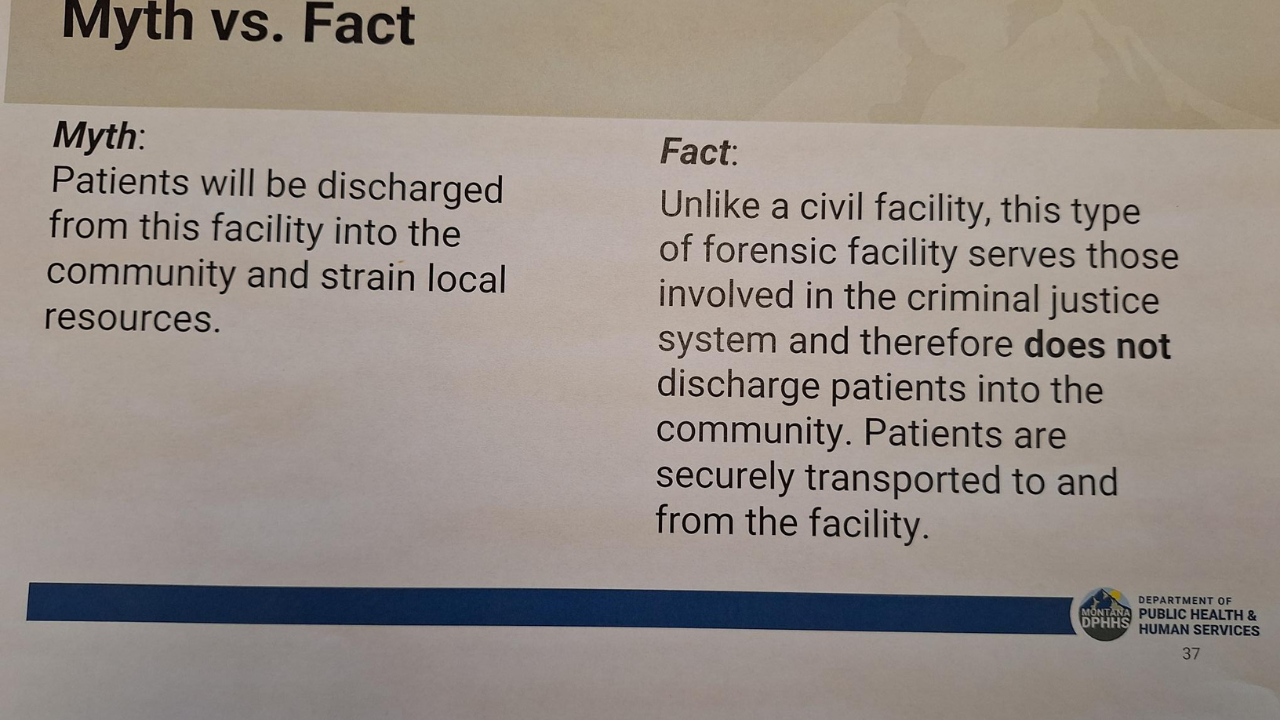
"Patients are securely transported to and from the facility, and the community arguably will never see these individuals or these patients. And that is a fact," said Brereton.
Yellowstone County Commissioner Mark Morse has long said the facility simply will not work in Laurel.
"That's right, and Laurel is still not the right place. There's not the work force here, and it's going to crush, as I've said before, it's going to crush our community mental health partners that we help support," Morse said.
Another myth presented by the state: The facility's close proximity to schools and homes is dangerous and will place Laurel residents at risk.

Montana Board of Investment Director Dan Villa says public health facilities like this one proposed for Laurel can coexist within residential areas.
"As you'll see, this is a secure hospital, not a correctional institution. There're no razor wires, there's no unsightly perimeter fencing. We are utilizing architectural security," Villa said.
While locals say they understand the likelihood of a possible escape is low, homeowner Amber Zahn says that's not enough to ease her concerns.
"You know, this is less than 50 yards away where my kids play. Is that going to trigger an inmate?" Zahn said.
Another myth: The Laurel City Council learned of the state's buy-sell agreement from the press, not the Board of Investments

Villa claims he told Laurel City Council members of the agreement first on Jan. 20 during a City Council meeting.
But Q2 reported the buy-sell agreement was in the works on Jan. 19.
It was the next day, Jan. 20, that BOI Director Dan Villa let council members know he had found a piece of land.
"The Montana Board of Investments has executed a buy-sell agreement to purchase approximately 114 acres located west of Laurel along Highway 10," Villa said.
Q2 news was also the first to make the Laurel City Council aware that architectural plans for the mental health facility existed. Q2 also reported this in the Jan. 19 story.
Whether these are myths or facts, one request from Laurel residents remains the same.
"Communication. There's been zero communication. Zero transparency," Zahn said.
