



HARLEM — Fifty years ago, the people of Harlem carefully packed a snapshot of their community into a time capsule.
Inside were photographs, newspapers, community signatures and everyday keepsakes, all sealed away during America's Bicentennial celebration in 1976 with instructions to open it a half-century later.
A simple plan, right?
The problem was that, over time, as Harlem changed and people passed or moved away, almost no one remembered where the time capsule had gone or that it even existed.
(WATCH: Nearly lost to history, Harlem's Bicentennial time capsule finally opens)
That mystery began to unravel when Blaine County Journal reporter Cody McCracken came across old newspaper articles documenting Harlem's Bicentennial celebration. Intrigued, he started calling longtime residents and city officials in hopes of tracking it down.
After several dead ends, McCracken reached Libby Kuntz.
Her late husband, Reuben Kuntz, had helped organize Harlem's 1976 Bicentennial celebration and quietly kept the time capsule in his safekeeping. Years later, as the family sorted through stored belongings, the capsule nearly ended up at the dump before Libby's daughter recognized it as something worth saving.
That decision ensured a unique piece of Harlem's history survived.
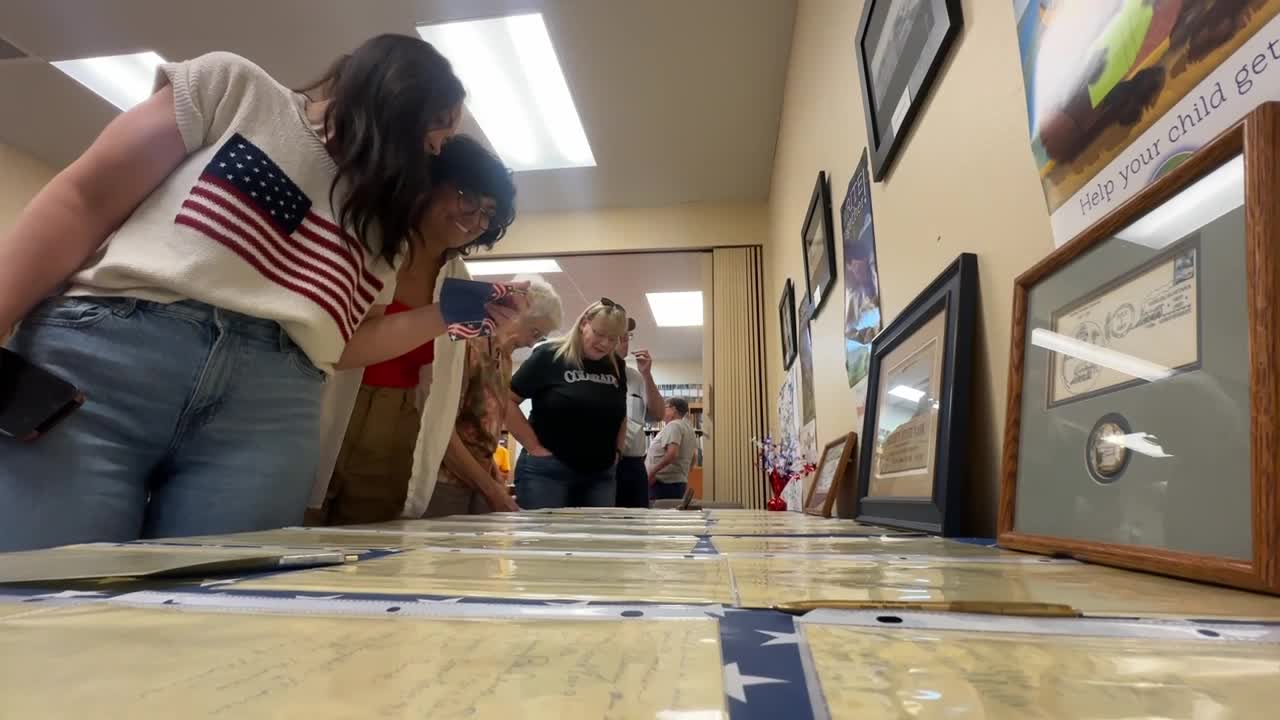
On Wednesday, community members gathered at the Harlem Library to finally open the capsule, discovering photographs, newspapers, event programs and pages of signatures from residents who gathered in 1976 to celebrate the nation's 200th birthday. The unveiling was organized by the Harlem Civic Association and Harlem Library as part of the community's lead-up to America's 250th anniversary.
For Libby Kuntz, one of the most meaningful discoveries wasn't an artifact at all. It was seeing familiar names.
Among them were the signatures of her late husband and parents, along with her son, who signed the register as a seven-year-old boy.
Longtime Harlem resident Ann Azure also found her own signature.
Azure attended the original Bicentennial celebration in 1976 and remembers a bustling Main Street filled with stores, restaurants and community events. Looking through the capsule, she said it brought back memories of a different era while reminding her what has always made Harlem special.
"The people," she said. "The people are special."
McCracken hopes the project encourages people to think about the history being created today.
"That's what defines these small towns and our history," he said. "It's our past that connects us. What we're doing now will be history one day, so we hope that someone remembers it."
