

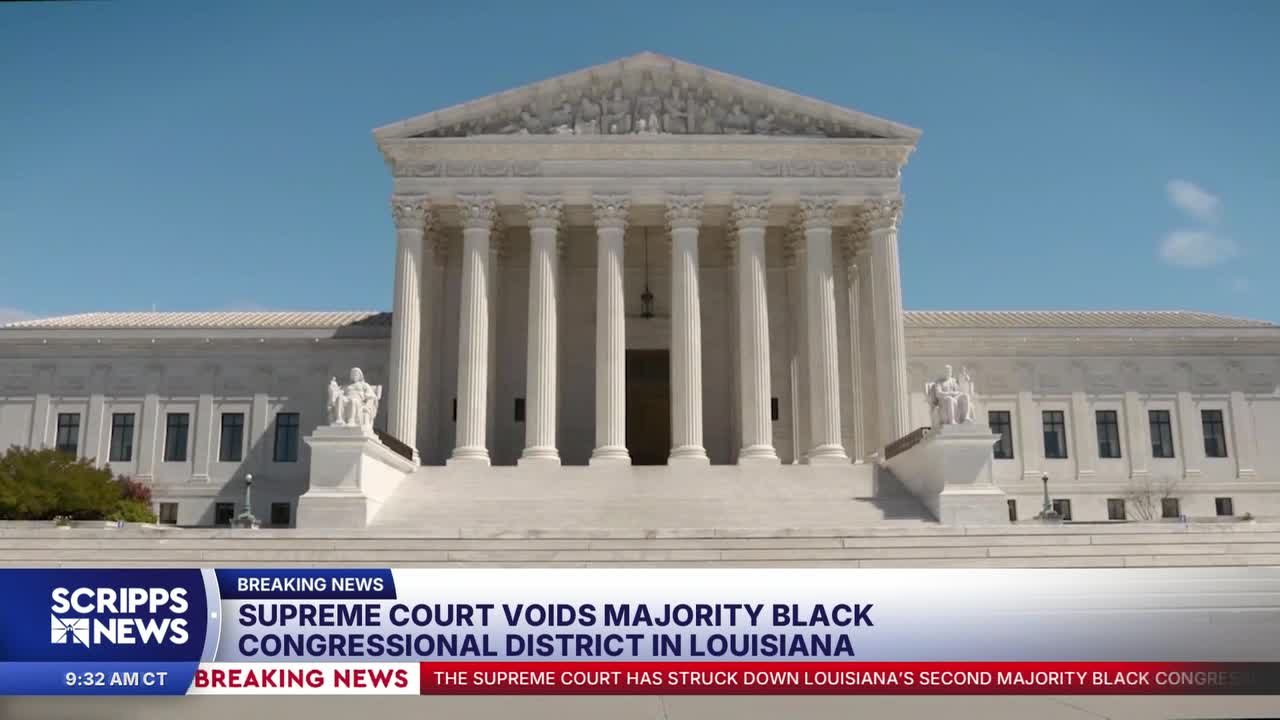


The U.S. Supreme Court ruled Wednesday in favor of Republicans by striking down a Black-majority U.S. House district in Louisiana.
The court’s six conservative justices formed the majority, while the three liberal justices dissented.
The ruling is expected to weaken the Voting Rights Act, which bars the drawing of congressional districts that dilute the voting power of minority groups. The decision could extend beyond Louisiana, potentially allowing other states to redraw their congressional maps in ways that give Republicans a greater advantage.
What the Supreme Court voting rights decision could mean amid a nationwide battle over redistricting
RELATED STORY | Virginia Supreme Court considers whether to block voter-approved US House map favoring Democrats
Louisiana’s 2021 congressional map created one majority-Black district out of six. Lower courts said that plan violated Section 2 of the Voting Rights Act. Lawmakers redrew the map to include two majority-Black districts, but opponents argued the second district also violated Section 2.
The Voting Rights Act has long been interpreted to prohibit mapmakers from diluting minority voting power through tactics such as “packing” or “cracking” voters into certain districts. Political gerrymandering, however — drawing maps to favor one party — has been permitted by the courts. In Louisiana, Black voters overwhelmingly support Democrats, while white voters tend to back Republicans.
“Section 2 of the Voting Rights Act has been a critical tool in safeguarding the promise that people of color can participate in our democracy on equal terms,” said Sophia Lin Lakin, director of the ACLU’s Voting Rights Project. “It has been our shield against discriminatory maps and our answer to laws designed to suppress the vote.”
Justice Samuel Alito, writing for the majority, said minority voters should not be treated differently than others.
“Because the Voting Rights Act did not require Louisiana to create an additional majority-minority district, no compelling interest justified the state’s use of race in creating SB8,” Alito wrote. “That map is an unconstitutional gerrymander, and its use would violate the plaintiffs’ constitutional rights.”
RELATED STORY | Threats and hoaxes target Indiana GOP senators in Trump’s redistricting push
Justice Elena Kagan, writing for the three liberal justices, said the majority undermined the law’s core protections.
“I dissent because Congress elected otherwise. I dissent because the court betrays its duty to faithfully implement the great statute Congress wrote. I dissent because the court’s decision will set back the foundational right Congress granted of racial equality in electoral opportunity,” Kagan wrote.
In the aftermath of the decision, former President Barack Obama said it "guts a key pillar of the Voting Rights Act" and now frees other states to gerrymander districts and "systematically dilute and weaken" the voting power of minorities.
"And it serves as just one more example of how a majority of the current Court seems intent on abandoning its vital role in ensuring equal participation in our democracy and protecting the rights of minority groups against majority overreach," Obama said.
