

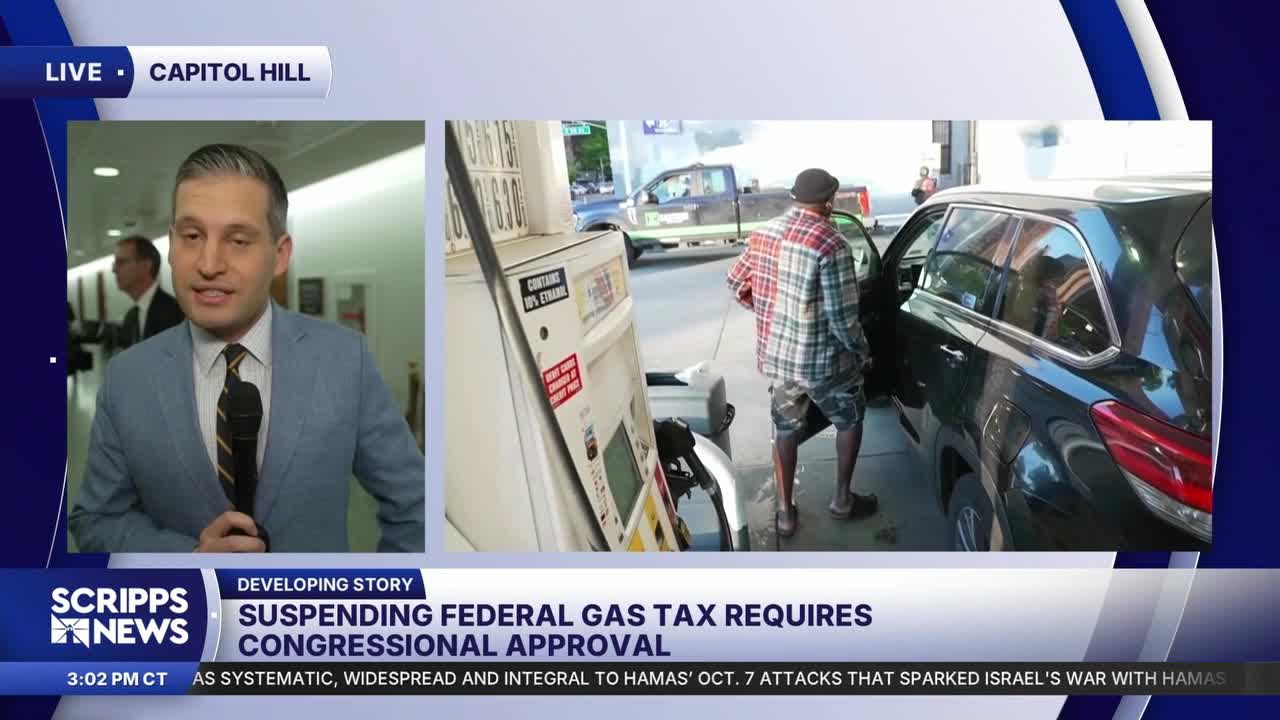


On Monday, President Trump said he wants to suspend the federal gas tax to try and bring down your pain at the pump.
But the proposal requires approval from Congress, which lawmakers in the past have refused to give.
This week, some Republicans on Capitol Hill sounded concerned about the effects lifting a gas tax would have on the federal programs it funds, and whether consumers would be the ones to see benefits.
"You probably know I've not in the past been a huge fan of previous attempts" to lift gas taxes, Senate Majority Leader John Thune said. "If the president wants to make that case, I think we're all willing to hear it. We've had some of our colleagues who've come out in support of repealing or at least temporarily repealing the gas tax. But obviously that has implications for the Highway Trust Fund. And those are things you have to take into consideration as well. And the question, of course, I always ask is if you did, it's 18.4 cents, I think, is that federal gas tax, if you lifted that, does that ultimately get passed onto the consumer?"
Democrats, meanwhile, have pointed to the Iran war as the cause of pump pressures, and continue to criticize the Trump administration for not giving adequate answers about the war's expected timeline and objectives.
RELATED NEWS | Strait of Hormuz tensions threaten to push gas past $5 a gallon by June
More than two months after the United States launched an attack on Iran, gas prices have risen more than $1.50 nationwide — and experts say they could climb higher in the coming weeks.
Patrick De Haan, head of petroleum analysis at GasBuddy, said the cost of a gallon of gas could exceed $5 if the Strait of Hormuz remains closed. The U.S. only briefly hit $5 gas in 2022, shortly after Russia invaded Ukraine, with prices peaking at a record $5.02 a gallon.
