

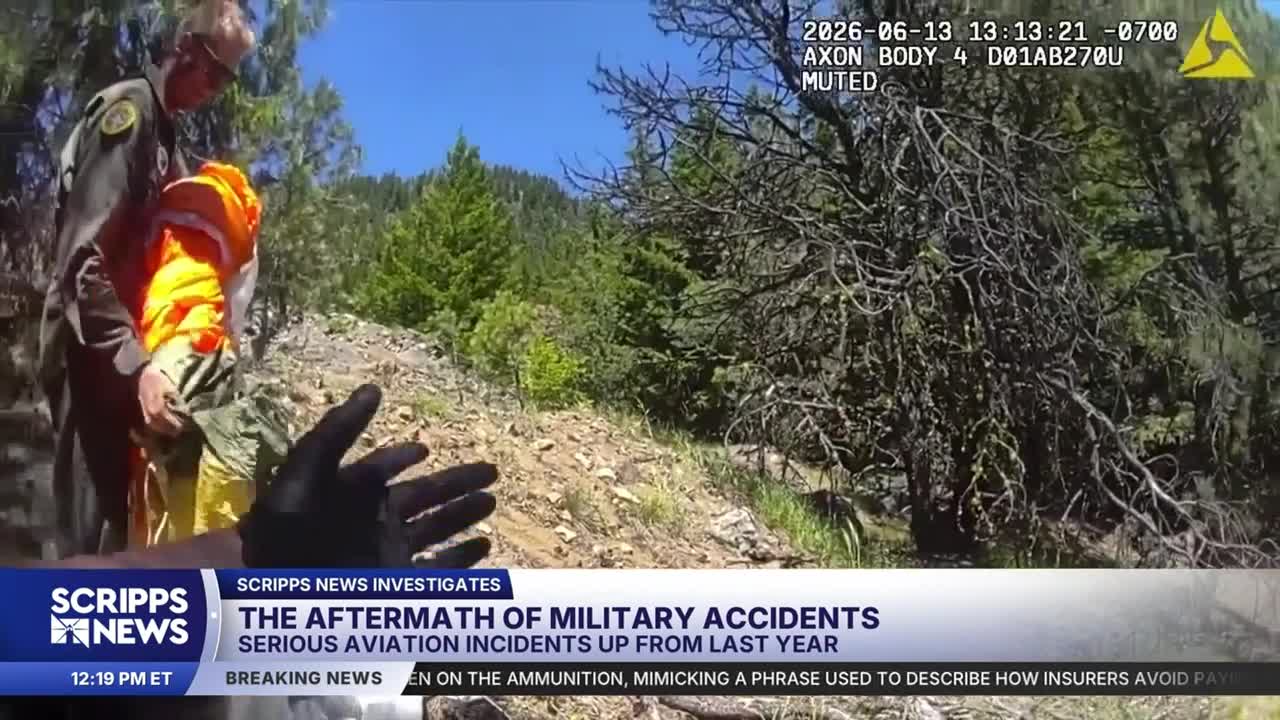


Moments before an F/A 18 Hornet fighter jet slammed into a Washington mountainside in June, its pilot was dazzling spectators with a series of thunderous maneuvers overhead.
People took out their cell phone cameras to capture his jet and another military aircraft practicing flight patterns near Rimrock Lake.
Then suddenly, one of the pilots ejected from his aircraft.
His fighter jet torpedoed into the ground, igniting a fireball in the trees followed by a massive cloud of black smoke.
Multiple spectators called 911, including one woman who was sobbing as she reported the accident.
“I just witnessed a jet crash, and there’s fire,” she told the dispatcher.
Then came the call from the pilot himself.
“I’m on the other side of the ridge,” he said. “I do see a fire burning to the south of the road. I can’t tell how bad that fire is.”
In body camera footage from the aftermath, the pilot, identified as Marine Corps Major Jackson T. Simon, seemed physically unaffected by the crash, though his face appeared to be covered in blood and dirt.

“We were doing some circles over the lake,” he told a deputy. “I tucked in, and I’m not sure exactly. Honestly, I’m a little frazzled,” he said. “I went through the trees.”
According to a military spokesperson, the destroyed aircraft was worth close to $67 million.
Many mishaps exceed the threshold for fatalities and cost
A Scripps News review of Class A “mishaps" — a military word for the accidents — found more than 50 severe non-combat aviation incidents in fiscal year 2026 in the Marine Corps, Navy, Army, and Air Force combined.
A Class A incident involves a fatality, a permanent disability, or equipment damages totaling at least $2.5 million.
Many times, Scripps News found, the human and financial cost of these incidents was far greater than the minimum.
For example, in September 2025, four members of the elite Night Stalkers special operations team were killed near Thurston County, Washington, after their MH-60 Black Hawk helicopter collided with transmission wires, according to military documents.
The crew included Jadalyn Good, Donavon Scott, Andrew Kraus, and Drew Scully.

While the military’s official safety investigation has not been released publicly, a state fire report from the Department of Natural Resources said the crew was on a training flight when they hit power lines.
The military has not yet disclosed publicly whether the collision with the powerlines was the cause of the crash.
A congressman and the Government Accountability Office weigh in on accountability
“For a major error like crashing an aircraft into powerlines to occur, all of the holes – think about multiple layers of Swiss cheese – all of the holes have to line up to allow that error trajectory to pass through all of the safety measures and ultimately result in a major loss of life,” said Rep. Gabe Evans, a Republican from Colorado.
Evans formerly worked as a Black Hawk pilot in the National Guard.

Aviation is a “risky business,” he said, with complex operations and missions — even in a training environment.
“You have to look at the culture of the organization,” said Evans. “You have to look long term at where there are shortcuts being taken.”
U.S. government accountability investigators are currently examining the military's safety culture across the branches.
“We have ongoing work that’s assessing the degree to which the department does have a positive safety culture,” said Diana Moldafsky, a GAO director responsible for reviewing military training and accidents. “That is something we’re going to look at closely,” she said.
In recent years, her office has made other recommendations for safety improvements after identifying heightened risks with the Osprey aircraft program, during special operations training, and with Army and National Guard helicopter accidents.
The Department of Defense has taken a number of steps, she said, to make improvements. “That said, there’s still room for more.”
“We found that a lot of the safety risks were associated with the aircraft not being available,” Moldafsky said. “Not enough aircraft – which meant there are fewer aircraft for the pilots, the air crew, to fly and train on. And that puts an increased burden on the air crews, which directly affects safety.”
The Department of Defense action
This year, the Department of Defense developed an Aviation Mishap Task Force to address many of the “concerning trends in aviation.”
In a written testimony for the Senate Armed Services Committee in May, the undersecretary of war for personnel and readiness, Anthony Tata, said the task force will “identify joint and systemic risk factors, including readiness degradation associated with repeated Continuing Resolutions (CRs), and deliver actionable policy recommendations. These recommendations will help to ensure that our warfighters have the predictable training, maintenance, and equipment needed to operate safely, effectively, and with lethal proficiency.”
