

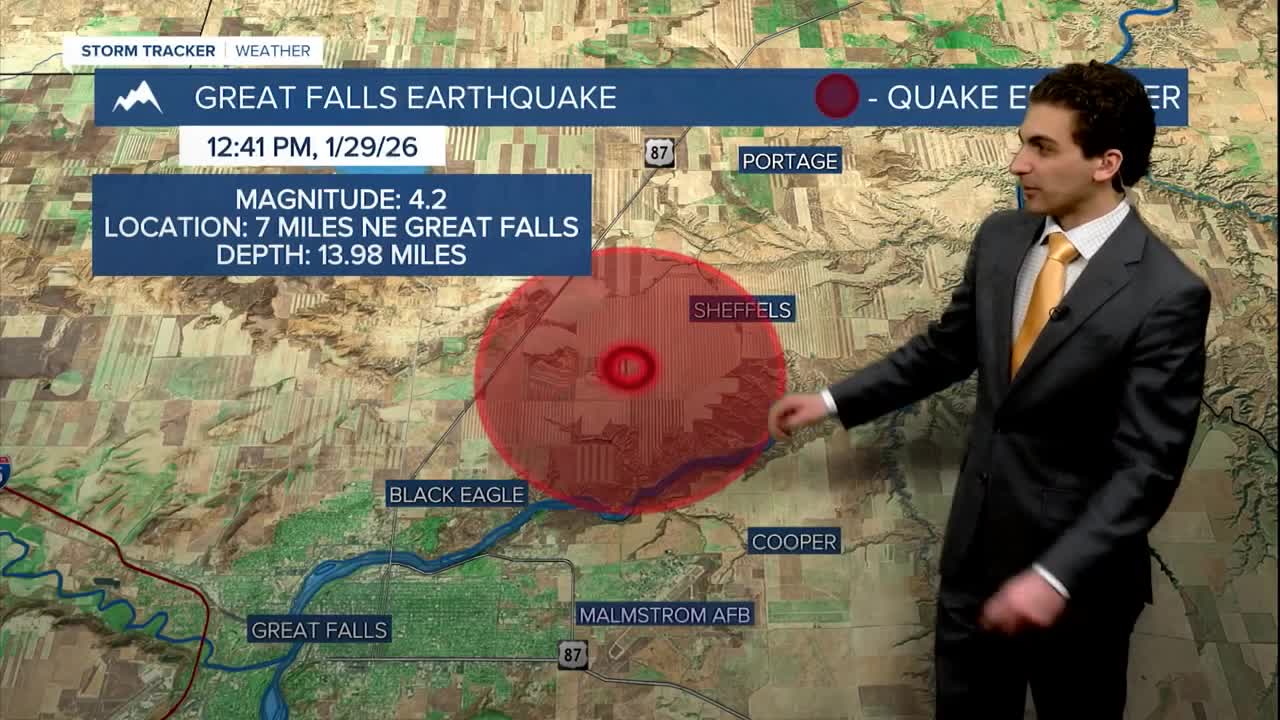


A 4.2 magnitude earthquake struck near Great Falls on Thursday, rattling residents across central Montana but causing minimal damage, according to the United States Geological Survey (USGS).
The earthquake occurred at 12:41 p.m. on Thursday, January 29th, about seven miles northeast of the city, close enough to the downtown area that many residents reported feeling shaking that lasted for up to 10 seconds. Despite the intensity of the shaking, only very minor issues, like pictures falling off the wall, occurred.

The tremor was felt far beyond Great Falls, with residents reporting light shaking from Kalispell, Cut Bank, and Shelby in the north to Helena and Butte the south, based on "Did You Feel It?" reports submitted to the USGS.
Although the origin of the earthquake is tough to pinpoint, an area we usually look to is the Intermountain Seismic Belt, a collection of faults that runs along the Rocky Mountain front through Helena and, eventually, into Yellowstone. When these faults rupture, they can produce significant earthquakes and sometimes trigger seismic activity further east of the belt, as occurred with Thursday's earthquake.

The rupture was relatively minor compared to other significant Montana earthquakes. The Lincoln earthquake in 2017 measured 5.8 magnitude, making it much stronger than Thursday's event. The Helena earthquake of 1935 was even more devastating, causing both property damage and deaths in the Helena area.
There was a small 2.8 magnitude earthquake recorded south of Mammoth in Yellowstone National Park at almost the same time as the Great Falls incident. While some Montanans are concerned that this hints at increased Yellowstone Caldera activity, there is no proof that this is the case.
According to the USGS, as seismic waves pass through the Earth's crust, they can trigger other quakes hundreds of miles away. This process is known as dynamic stress transfer.
The most recent Yellowstone Volcano Observatory update, at the beginning of January, says the Yellowstone Caldera activity remains at background levels.
There remains a small risk of aftershocks, and we have already felt one around Great Falls. A small aftershock measuring 2.7 on the Richter scale was recorded near the same area just before 6:00 p.m. on Thursday.
