



CANYON FERRY — A group of spectators in Canyon Ferry joined many Montanans early Tuesday morning to view a total lunar eclipse. But these "early risers" were able to take advantage of the state-of-the-art telescopes offered at the Montana Learning Center.
Ryan Hannahoe, Executive Director of the Montana Learning Center, was on hand with specialized equipment to capture the rare celestial event and explain the science behind it.
WATCH: INTERVIEW WITH RYAN HANNAHOE UNDER THE BLOOD MOON
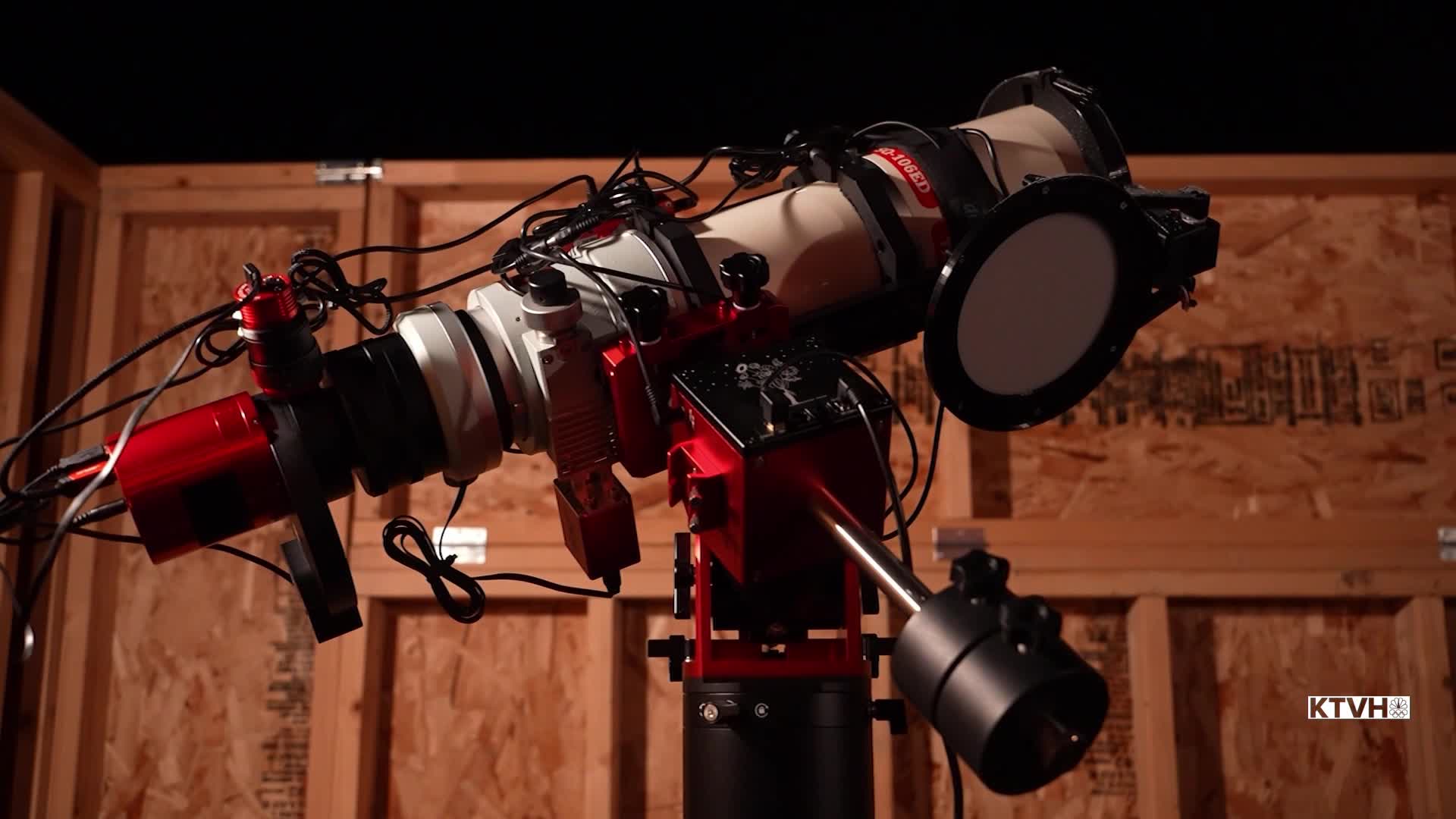
Hannahoe used a 4-inch refracting telescope equipped with a full-frame sensor to photograph the eclipse, producing high-definition images of up to 50 megapixels. That is detailed enough, he said, to print on a poster or even a billboard.
He even has a live feed of the telescope streaming locally on a TV screen for spectators to witness.
A total lunar eclipse occurs when Earth passes directly between the Sun and the Moon, casting a shadow across the Moon's surface and causing it to turn a deep reddish-orange for a short time. A lunar eclipse only occurs during the full moon phase.
Hannahoe had great insight into why we see the color red during a total lunar eclipse. He said, "With the Earth covering the sun directly, we're able to see that blood red. Because what we're seeing now is the Earth's shadow on the moon. And so, you know, because of how light works and how it bends, that's why we're seeing the red,"
This was the last total lunar eclipse visible from Earth until December 31, 2028. The next one visible in Montana won't come around until June 26, 2029.
You can learn more about the Montana Learning Center's observatories and programs here.
